Waxing Eastward: Why UK Record Shops Are Clearing Shelf Space for City Pop and K-Indie
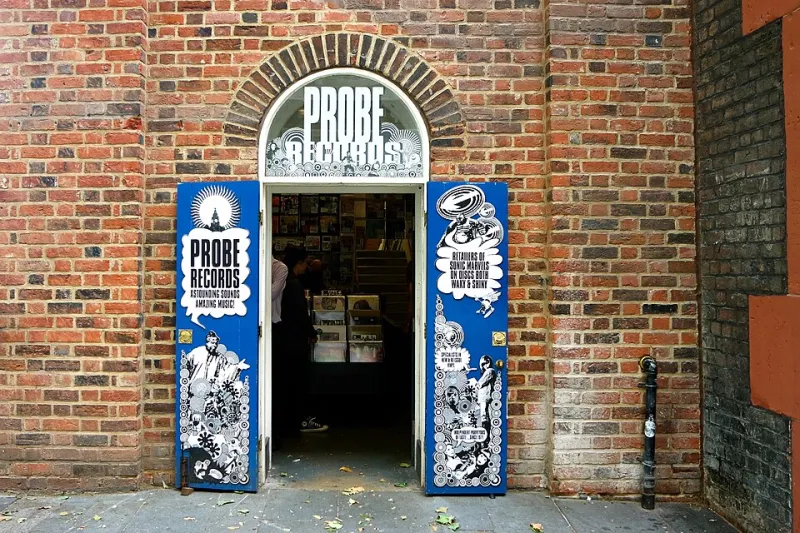
Photo: Matt Harrop , CC BY-SA 2.0, via Wikimedia Commons
There's a shelf in most independent record shops that has quietly become the most interesting part of the room. It's usually near the front, sometimes on an end, and it's almost always hand-written: JAPAN / KOREA, or ASIA, or — if the staff are feeling playful — CITY POP & FRIENDS.
Five years ago that shelf was two Miki Matsubara compilations and a second-hand copy of something nobody could identify. Now it's a fixture, and the shops are betting money on it.
The shelf by the window
"You put it by the door because it sells," says the manager of a shop in Manchester's Northern Quarter. "It's visual. People pick things up because the sleeve looks like a 1980s holiday brochure, and then they buy it because the music's good. That's a brilliant combination if you're a record shop."
That logic has driven a decade of reissue activity. Light in the Attic's Pacific Breeze compilations turned a niche curiosity into a gateway, and the major Japanese labels noticed. Sony's Great Tracks series, Universal's own city pop reissues, and a steady flow of licensed pressings have made 1979–1989 Japanese pop one of the most reliably stocked genres in the country — a rare thing in a market where a reissue has to justify itself against a thousand other reissues.
How city pop became a safe bet
It's tempting to credit the whole thing to one song going viral, and there's some truth in that. But the reason shops keep ordering is more mundane: the records are beautiful, they're mostly cheap to license, and they age well in a shop window.
A standard city pop reissue lands somewhere between £28 and £34 in the UK. That's not a bargain, but it's in the zone where a curious buyer will take a punt on a sleeve alone. The audience stretches well past K-pop fans — a lot of these records go home with people who like soul, boogie, soft rock, or anything with a fretless bass and a saxophone solo.
"The customer isn't always the person you'd expect," a buyer at a Bristol shop tells me. "It's dad rock money being spent on a record from Tokyo. That's a nice market to be in."
Korean indie is a harder sell, and that's the point
If city pop is the easy half of the shelf, the Korean indie section is the interesting half. Pressings are small — sometimes a few hundred copies — shipping is expensive, and licensing is a conversation rather than a catalogue. The result is a section that changes constantly and rarely restocks.
Which is exactly why it works. Shops have learned that scarcity isn't a bug in this corner of the market; it's the personality. A customer who misses a pressing comes back next month. A customer who finds one tells somebody.
The import maths
Underneath all the romance is a spreadsheet. UK shops buying from Japan and Korea are dealing with freight, import VAT, customs handling and a distributor chain that's often one person with a warehouse and a good memory. A single Korean indie LP can land on a UK shelf at £38–£45 once everything's added — a price that requires a buyer with conviction.
Some shops handle it by buying deep on guaranteed sellers and shallow on everything else. Others have leaned into a wholesale sideline, supplying smaller shops and online stores that can't justify a direct order. And a few have stopped pretending to be comprehensive, stocking only what they can defend.
"We don't try to be a complete catalogue," says one Glasgow buyer. "We try to be a good edit. If it's boring, it doesn't go on the wall."
The sceptics' case
Not everyone is convinced. The obvious critique is that this is a seasonal curiosity — that a shelf of sunset-drenched sleeves sells to people buying a gift, not to people building a collection. Shops have heard it for years, and most of them find it slightly lazy.
"The gift-buyer argument was made about soul reissues, about jazz, about everything," one manager says. "Some of those gift buyers come back. That's the whole business model."
A fairer worry is depth. There's a limit to how many times the same twenty Japanese albums can be reissued before the shelf starts to feel like a loop, and the Korean side is limited by manufacturing capacity and by how few back catalogues have been properly licensed for vinyl at all. The floor is solid. The ceiling is genuinely unknown.
Where this goes next
What seems clear is that the shelf has stopped being a novelty and started being infrastructure. Shops are hiring buyers with knowledge of the region, a handful of UK distributors now specialise in East Asian catalogue, and there's a generation of customers who file Japanese boogie next to British soul without thinking twice.
Whether that survives the next round of price rises is another question — and it's one that'll be answered not by TikTok, but by whether anyone still walks in on a Saturday and takes a £32 record home.